Meet Scout: Our YouTube Creator Research Agent (v1.1)
Our YouTube creator research agent Scout is alive today. Ask it anything about any creator on YouTube, in plain English, and get vetted answers in seconds.

Everyone please welcome Scout the pigeon.
More specifically, Scout is our new research pigeon. Scout spends all day watching YouTube: reading channels, checking who sponsors whom, noting which audiences actually trust which creators. And when you need YouTube creators to promote your brand, you don't fill out a form or export a spreadsheet. You just ask.
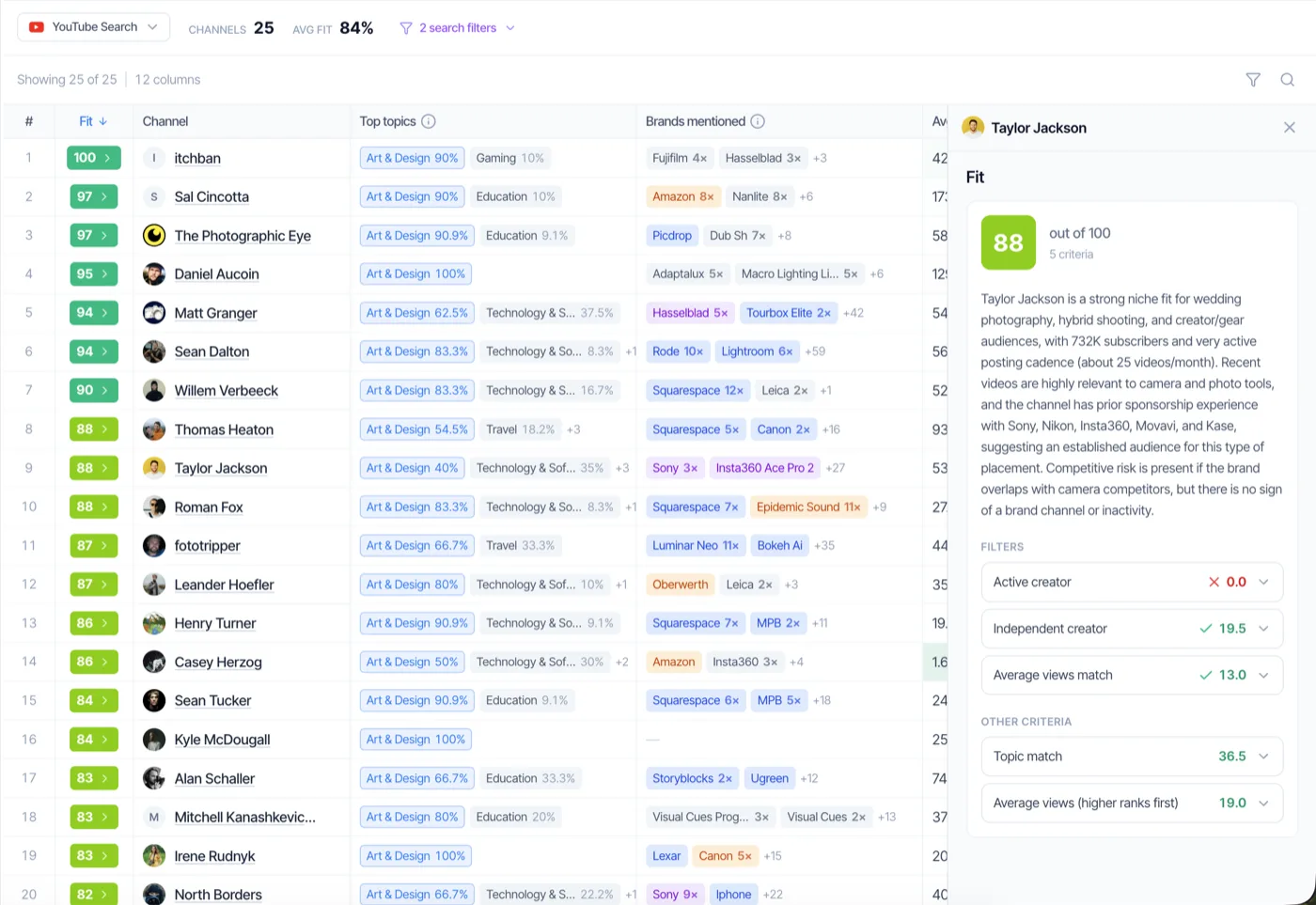
"Find country music channels who have mentioned Mountain Dew recently." Scout comes back in seconds with a ranked list, fit scores, and sponsor history attached.
That's the whole product. Today it's live at babbl-labs.com, and I want to tell you why we built it, how it works, and what a pigeon has to do with any of it.
Finding Creators Was Never a Skill Issue
If you're new here, a quick version of a story I've told before.
At my last startup, we had every reason to run YouTube creator campaigns. Our audience lived there. We never pulled it off. Not because we lacked judgment, but because the work before the judgment was brutal: find candidate channels, actually watch their content, figure out if the audience is real, dig through which brands already sponsor creators like them, and then repeat all of that across enough channels to build a shortlist. Usually 2-3 weeks of grind before you've messaged a single creator.
Then at Babbl Labs we ended up on the other side of it. Brands asked us to run their YouTube programs, and we've now run hundreds of creator partnerships (2,000+ sponsorships facilitated for brands like Liberty Safe, Henson Shaving, and Aftershoot). Doing it at volume taught us the lesson that became this product: what keeps brands out of creator marketing isn't talent, it's logistics. Deciding on a creator takes minutes. Earning the right to decide takes days.
Meanwhile the stakes keep going up. Brand-sponsored videos on YouTube grew 54% year over year in 2025. YouTube has been the #1 platform on U.S. television for twelve straight months, ahead of Netflix and every broadcast network. Every brand with a real marketing budget knows creators have to be part of it. Almost none of them have the hours to find the right ones. So we built the thing that does the hours.
Why Scout is a Pigeon
Scout is a pigeon, and yes: pigeons get a bad rap. But people underestimate pigeons. For about 3,000 years, when a message absolutely had to get somewhere, you sent a pigeon. Some even won medals for bravery during WWI. They fly out, they cover absurd amounts of ground, and they come back with the goods. That is precisely the job here: Scout flies out over hundreds of thousands of YouTube channels, does your recon, and comes back with a short list worth your time (also, our agent needed a name, and "YouTube Creator Research Agent v1.1" doesn't fit on a jersey). We hope he will serve to restore dignity to the regal order of pigeons all over the world.
What's New with Scout v1.1
We launched v1.0 of the agent three weeks ago (prior to that, our v0 was doing this for brands in overcooked spreadsheets). v1 was our first attempt at a real live dashboard. The response told us we were exactly right about the problem, and not done with the product. In v1, you gave the agent your brand URL and it came back with recommended YouTubers. Useful, but one-shot. Watching people use it (our own team + dozens of early-access users, on real client campaigns, every day) made the gap obvious: creator research isn't one question. It's a conversation.
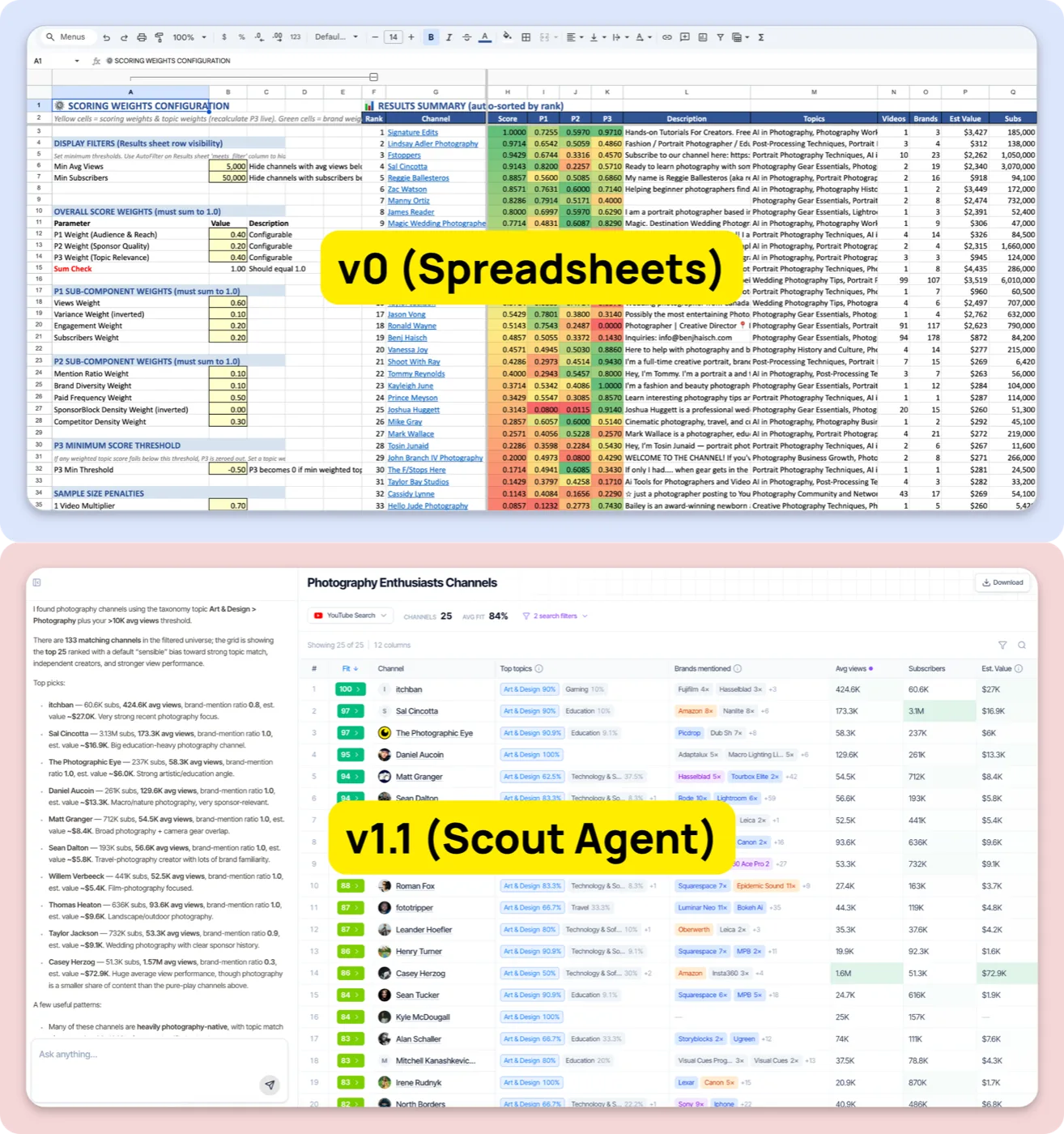
So we took that to heart. We tore the whole thing down and pretty much rebuilt the entire thing. Now the whole agent interaction model is built around asking. You can ask it anything, in plain English, with answers in seconds instead of a report you wait on:
- Just ask: "Find wedding photography channels"
- Get specific: "Tech channels mentioning Claude 4.8"
- Get nosy: "Channels sponsored by Surfshark recently"
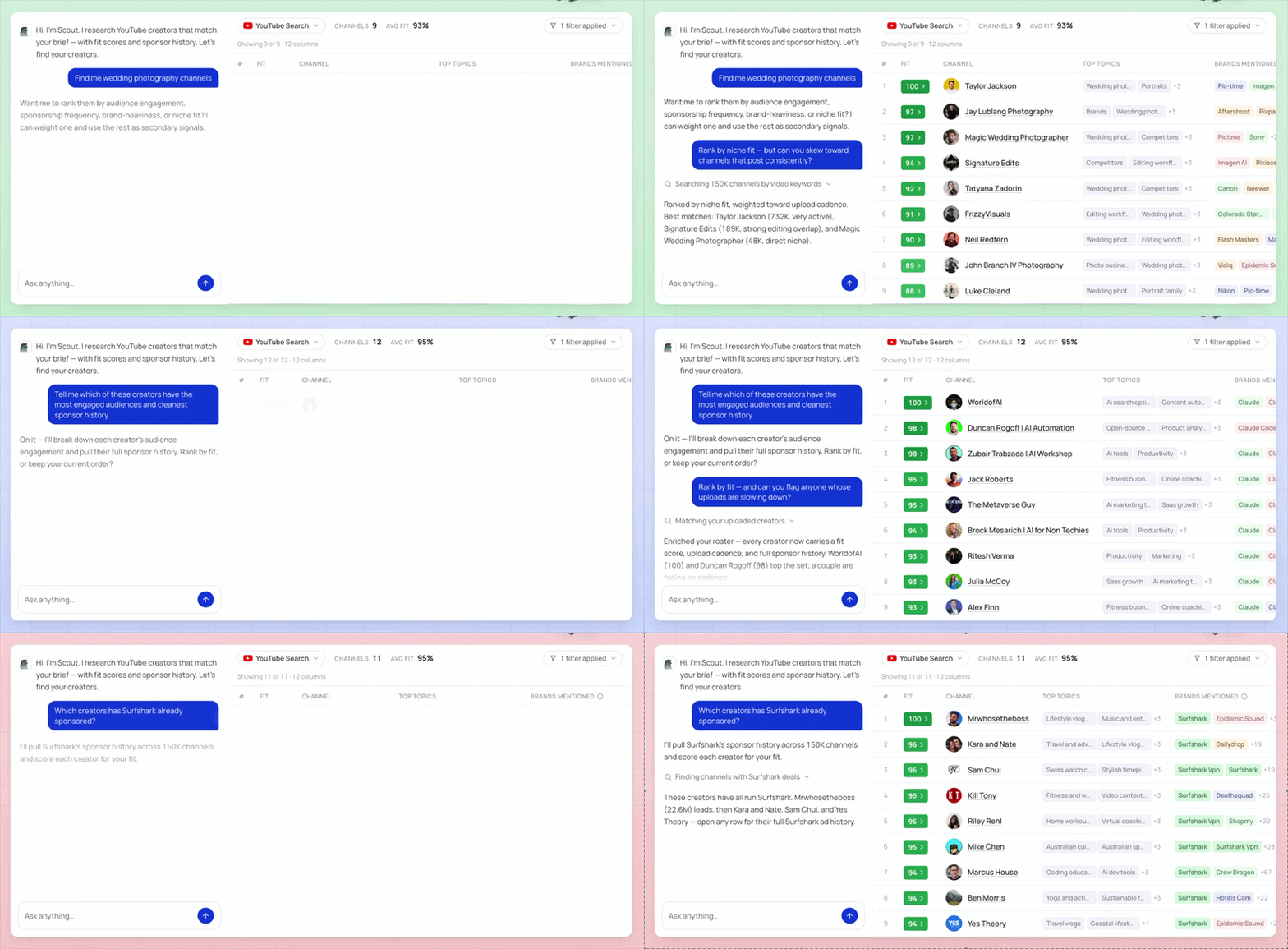
That last one deserves a second look. Your competitors' sponsorship history is public information, sitting in plain sight across thousands of videos. Nobody has time to go watch for it. Scout already has.
And better yet, once you have a roster, Scout keeps working: enrich the creators you're already tracking, or watch which brands are sponsoring channels that overlap with yours. That's the power of an agent like Scout.
What's Under the Hood
Now, here's the part I care most about - the technical details. Because it's the difference between this and every filter-and-export tool you've tried.
Scout doesn't search stale directories like other tools. It works from the data layer we've spent the past years building: actual video content, processed at scale. When a channel takes a sponsorship, discloses a partnership, mentions a brand, shifts its content, that's in the videos themselves, not in anyone's metadata.
It takes an expert to see that and recognize it by hand. But Scout is built with that knowledge, so Scout can extract it, like an expert would. That becomes real sponsor history (who paid whom, how often, how recently), real engagement patterns, and real audience signals rather than follower counts.
On top of that layer, Scout scores every creator's fit to your brand across a few pillars: category match, audience match (who they reach and why people watch, whether that's education, entertainment, or tutorials), sponsorship match against your competitors and adjacent brands, rate match against your budget, and trust, which is the one everyone feels but nobody measures. We built that scoring framework with CMOs who live in these deals; it's the same rubric we use when we run campaigns ourselves.
"This is way better than anything I've seen. I've done this 10 years and have never found anyone who could give me 10+ really good leads every time like this."
— Ashly Knox, CMO, Henson Shaving
A database hands you rows and wishes you luck. An agency does the thinking and charges $5K a month for it. Scout does agency-quality research at software prices, and for hundreds of the creators it surfaces, we've already onboarded them to our partner program with verified contact paths, real rates, and real demographics. The intro is one click, not a detective mission.
Try it Now, For Free
babbl-labs.com. Your first search is free, no account required. Type what you'd have typed into a spreadsheet header at 11pm and see what comes back.
And because we're officially launching this week, one more offer: if you want help getting set up, grab time with us. Just book a demo and we'll load your account with 1,000 free credits and I'll personally work through your first briefs with you, 1:1, until Scout is finding creators you'd actually book. We're a small team and I genuinely want to watch people use this thing.
Where This Goes Next
We've got a few extremely exciting upcoming feature launches already slated, including more to do with handling the downstream creator connection and deal facilitation (no spoilers). We also know there is a whole influencer universe beyond YouTube; Scout's first territory is YouTube because it's the platform where trust lives and the one that blocked us most. But it won't be the last: the same data layer extends to X, Instagram, and beyond, and that work is already underway for later this summer.
The shortlist was also only ever the beginning. Outreach, negotiation, creative, attribution: every step after research has the same shape, too much manual work standing between you and a decision. That's the roadmap, and we'll keep building it in public, wins and losses included. Cheers to making creator partnerships something every brand can manage. Scout's on the roof, watching.

Peace,
Ramsey, Sam, Scout & the team