Scout Finds The Creators You Didn't Know You Needed
Your customers don't fit in a box, so stop searching for one. Scout reads your brand and goes where they already are.

We care about one thing at Babbl: finding you YouTube creators that help you achieve your goals: signups, sales, awareness, site traffic, etc. The creators whose audience is your customer, even when their videos have nothing to do with your product.
A few weeks ago a CMO told us she'd pay $500 a lead if we could find her the perfect creators. We've spent most waking hours since then trying to be worth that. In that stretch we realized the prerequisites to searching are the issue.
So as of today, Scout is diligent in its homework before it looks for anyone. Here's the problem, the thinking, and what came out of it.
The Problem
Creator search shears. It doesn't cut.
Every tool, including the old Scout, starts the same way: you type what you think you're looking for. "Fashion creators." "Fitness YouTubers." "Service provider creators."
In turn handing back channels that talk specifically about that thing. The results are what you asked for but feel off. Stress test being: if I were watching this video would I wanna buy my stuff when they mention it?
Your buyer isn't watching channels about your product (trust us, we know its counterintuitive). They're watching channels about their life, hobbies and interests.
A men's apparel brand's customer is a guy in his 30s who watches bbq tips, sports wrapups and industry breakdowns for work, not fashion.
A company that sells AI receptionists to plumbers needs channels that plumbers watch, which are about running a trade business, not about AI.
(one of these is the exact reason a customer gave us for leaving. thank you for the feedback good bad and ugly, it makes us better :)
Most people have had this problem on every search they've ever run and never named it. Keywords match the category, category doesn't match audience.
Problem 2: you don't know what to type.
While you know your brand like the back of your hand, a search bar asks for one line, and your brand is:
- who buys it
- who you're up against
- what you sound like
- what size channel your budget can carry
- what you're trying to make happen.
Its really hard to fit vibes and context and history into a line of a searchbox, and easier to be frustrated trying to put this into words.
What a Good Search Would Need to Know
If we were going to fix this properly, Scout HAD to know five things before it ran anything:
- Who actually buys this. The actual person, with a job and a Tuesday night.
- Who is already sponsoring in the lane, and which creators they used. That's proof of fit with a price attached, and the BESt starting point for your brand's strategy when working with creators. Their wins are there to read if you look, or you can let Scout draw the conclusion for you.
- What the brand sounds like. Voice doesn't limit which channels you can sponsor. It decides how the read should sound once you're there, and whether that read serves the goal.
- What the budget can accomplish. Sort by views to subscribers and the right size shows up on its own.
- Which creators are trustworthy. Sponsorship track record, upload cadence, verified data. The stuff you'd check yourself if you had a week.
One constraint: it can only take a few minutes, with you, then it's done. Anything longer felt like a disservice to the self-serve goal of Scout: help every brand win at YouTube creator marketing.
What We Kept and What We Dropped
There are ways to get this done. We went through each one and took the part that worked.
The in-house manager or agency. The best thing about them is that someone sits with your brand before they touch a list. We kept that and dropped the time + retainer.
The creator databases. Great filters, real scale- kept both. Dropping the part where you have to already know what to type.
The old Scout. The sponsorship index and the search engine were the right foundation. The keyword as the starting point had to go.
Chat AI. It knows your brand well enough. It can't search 100K+ YouTube creators with their sponsorship history, so the knowledge never turns into a actionable creator shortlist.
Put those together and the shape of the answer is obvious: something that does the homework a good manager would, in the time it takes a database to return a query.
The Brand Brief
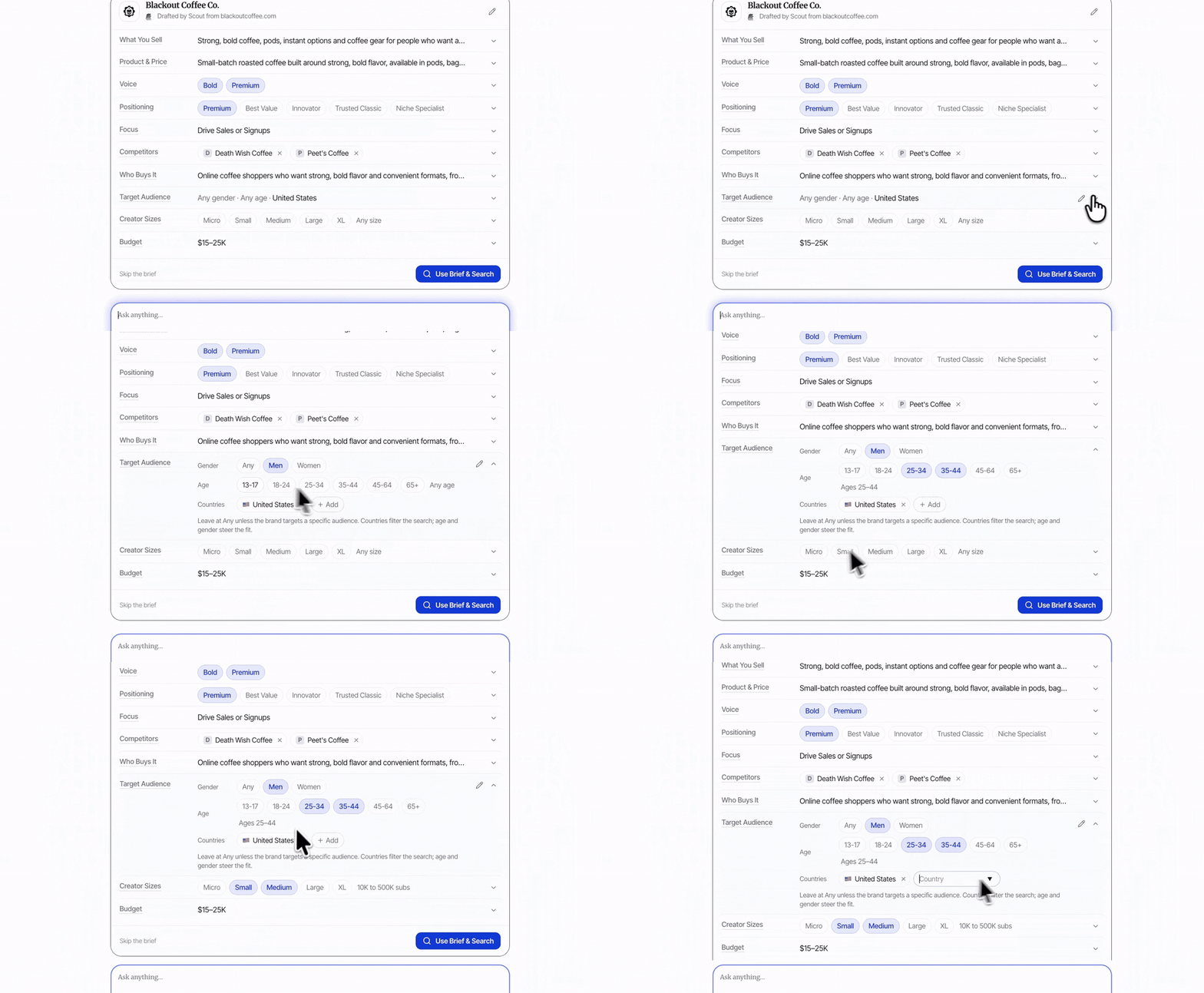
The solution: a Brand Brief, written as a collaboration between yourself and Scout.
Give Scout your URL in the same sentence as your ask. Scout then reads your site, every page, plus what's said about you elsewhere, and drafts the brief:
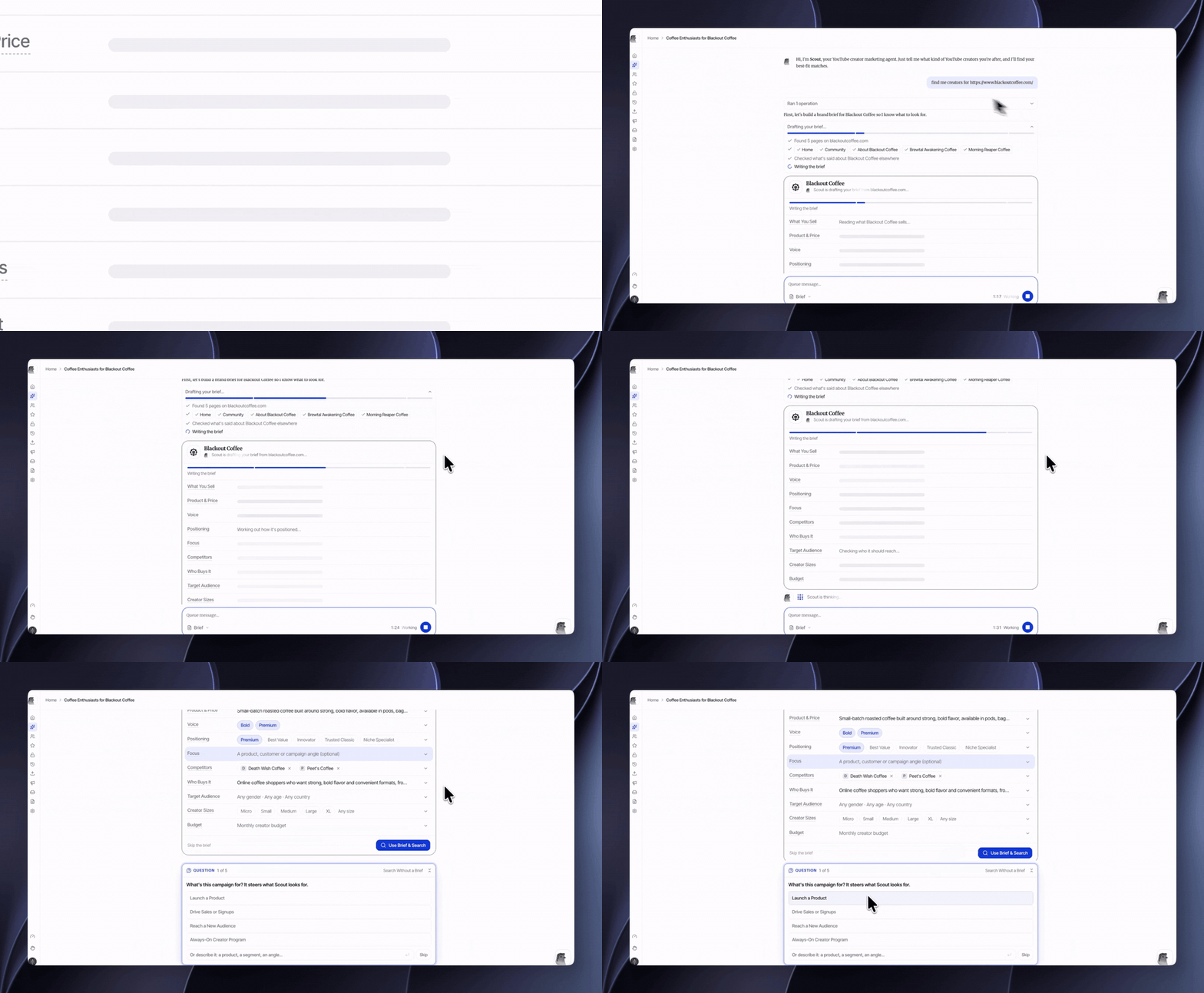
- what you sell
- what it costs
- who buys it
- your competitors
- your voice
- your positioning
- the creator sizes that make sense
- a budget range.
Every row is editable. If it got your voice wrong, make it right. If it missed a competitor you're looking to beat out, add them. Like we said, the goal is collaboration, allowing Scout to be the best at its job: finding you the best creators for your brand's goals.
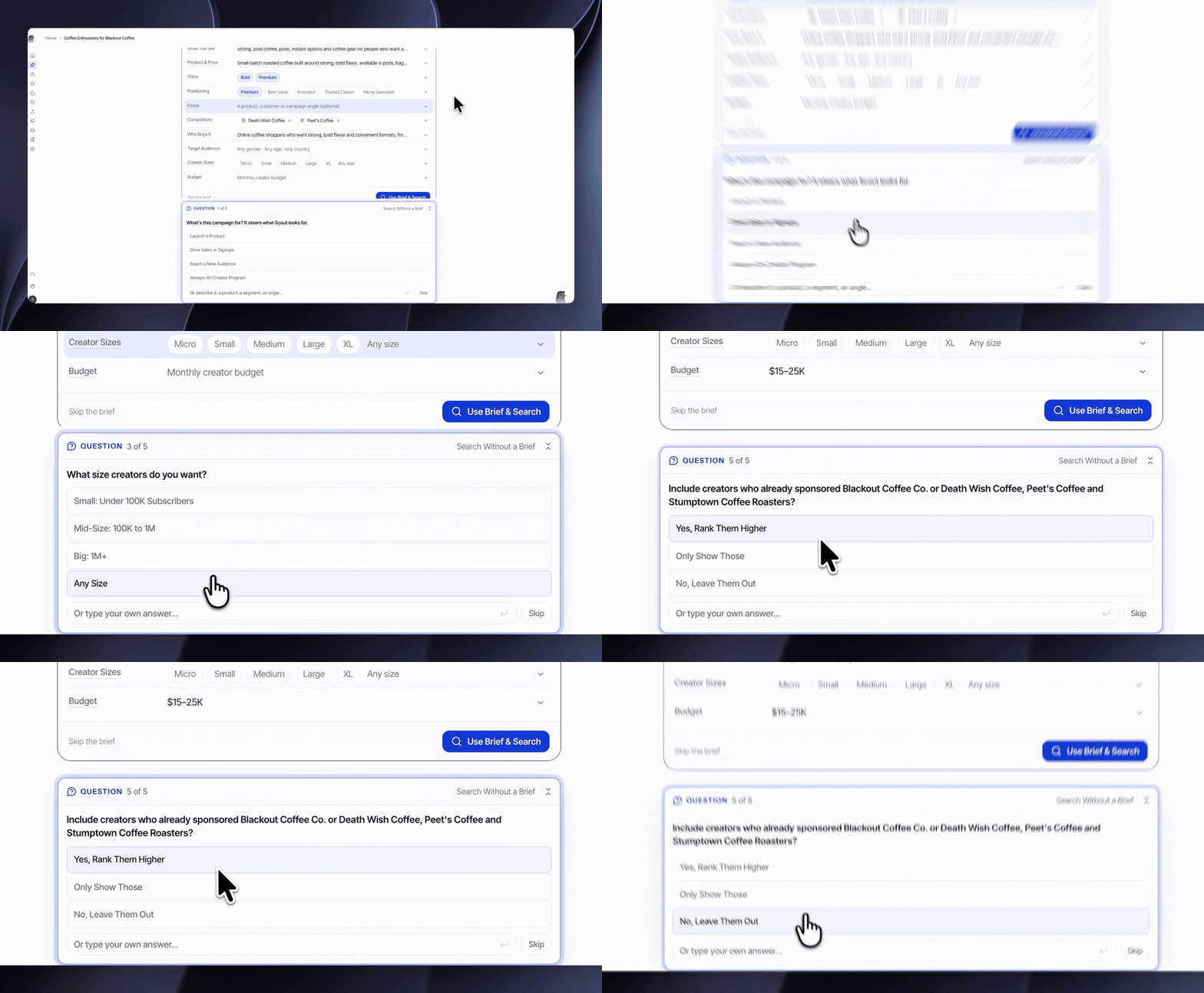
Scout asks a few questions, the types only you can answer. What this campaign is for. Where your customers are. What size of creator you want. What the monthly budget is. Whether to include creators your competitors already sponsor.
This is the guiding light, and now every search runs on it. Each creator is scored for fit against YOUR brand, with the reasoning written out.
To be clear: nobody sends this brief to a creator. It's Scout's understanding of you, built so the search is right. It's the part a good influencer manager does in their head on day one, written down where you can correct it.
The Details
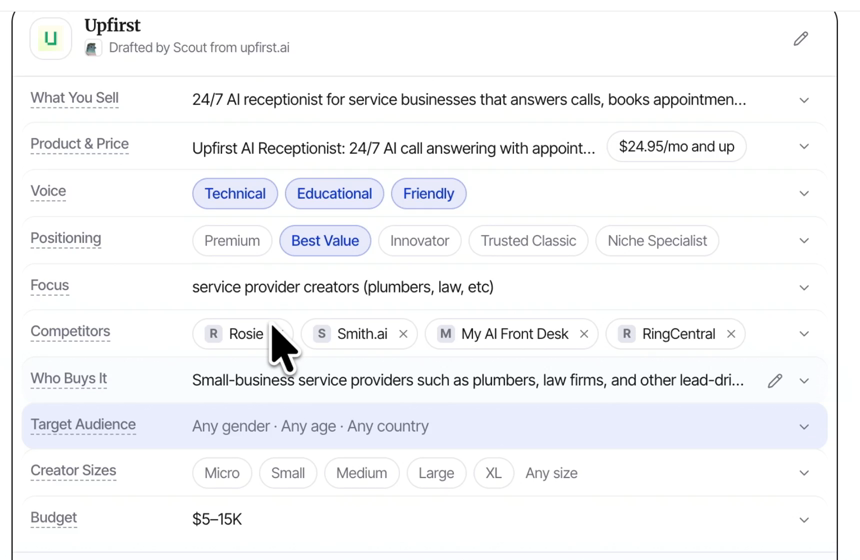
The competitors row is the one that gets people. On the run above, Scout read upfirst.ai and put Rosie, Smith.ai, My AI Front Desk and RingCentral in the brief. Nobody typed a name.
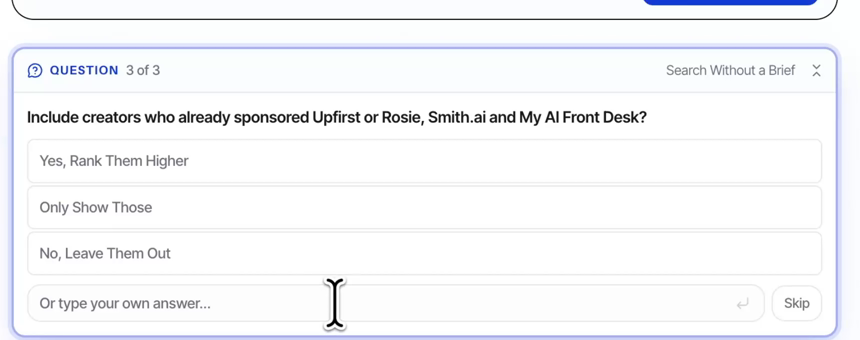
The third question exists because Scout already checks who those competitors have paid and the videos they did it in.
"Who's already selling to my customer" becomes a click. Rank them higher, show only them, or leave them out.
And the brief's own line for who buys it, which Scout wrote and we didn't touch: small service-business owners in phone-led businesses who want to stop losing leads. That one sentence is why the creator list below looks the way it does.
What It Feels Like
One sentence with your domain in it. A collaboration you own, in turn providing you the creator marketing hire you always wanted.
Want the longer version of what to type? The Scout prompting guide covers it, and how to sponsor YouTubers is the full brand-side playbook, from reading a sponsorship history to pricing a deal.
The Demonstration
Here's the full run on Upfirst, an AI receptionist for service providers, start to finish.
The ask was "service provider creators." Scout mapped that to business and entrepreneurship, layered in service business, plumbing, law firm and contractor, applied the brief's US-only and under-500K constraints, and ranked creators who'd worked with Upfirst's competitors higher.
Scouts findings, in its own words: the strongest results skew toward home-service and trades operators and service-business growth creators, which is a very natural fit for Upfirst.
A few of the 25, with Scout's reasons:
- Pavlo. 132K subscribers, 93% brand-mention ratio. Content centers on local-business marketing, client acquisition and contractor marketing.
- Contractor Fight TV. 89.8K subscribers. Sales training for contractors and field-service owners.
- DIY with Dave. 224K subscribers, 83.8K average views, 100% brand-mention ratio. A broader trade-adjacent audience with real sponsorship receptivity.
- Zues Ordaz. 184K subscribers, 90% brand-mention ratio. Leans AI and business automation, still squarely Upfirst's buyer.
Every one of those channels is watched by someone who picks up the phone for a living and hates missing calls. Scout's own closing note on the pass: a few broader business and AI creators surfaced too, but prioritize the trade and service-operator channels first if the goal is efficient fit.
That's the whole point in one sentence. Creators you didn't know you needed.
Try It
- Open Scout and tell it what you want, with your domain in the sentence.
- Read the brief. Fix anything it got wrong.
- Answer a few questions. Search.
Make a brief, and for every edit you have to make, we'll give you a free creator unlock.